
What AI Can & Cannot Do for Investment Marketing Teams
AI Use Cases, Strategic Limits, and Integration Best Practices
Key Points
-
AI excels at speed, scale, and pattern-based execution across marketing operations.
-
AI struggles with original thinking, creative differentiation, and institutional brand judgment.
-
The strongest investment marketing outcomes combine AI-enabled efficiency with human-led strategy and creative direction.
Artificial intelligence is now embedded in the marketing workflows of many investment firms. With proper direction and standards, it can accelerate execution across the stack.
It has also made much of the output across the industry look and sound the same, particularly when positioning and narrative decisions are left to automation.
What AI still cannot do is exercise judgment or accountability. It cannot determine what to emphasize, what should be left out, or how to signal confidence through restraint. It does not set a defensible market position, design credibility into a brand system, or build narratives that withstand institutional scrutiny. Those decisions require context, experience, and discernment.
This article outlines where AI in investment marketing meaningfully improves the execution, where its limits introduce risk, and why firms that rely on AI alone tend to swim in the sea of sameness rather than stand out.
Where AI Adds Real Value in Investment Marketing
1. Research, Analysis, and Synthesis
AI accelerates tasks that once required significant manual effort:
-
- Keyword and topic clustering for SEO and AEO
- Competitive content analysis
- Summarizing market research and regulatory language
- Extracting themes from large data sets or CRM histories
For investment firms, this shortens planning cycles and can help enhance visibility into how prospects search, evaluate, and compare managers.
2. Content Operations and Scale
AI can reliably facilitate:
-
- Drafting first-pass outlines and FAQ-style content
- Repurposing long-form content across channels
- Metadata generation, schema support, and internal linking logic
- Localization and format adaptation
Used correctly, AI reduces friction in content production without dictating the final message.
3. Workflow Automation and Performance Optimization
AI tools increasingly support:
-
- Campaign reporting and attribution modeling
- A/B testing and conversion optimization
- Expert conversational agents for prospect engagement and conversion
- Autonomous workflow orchestration across internal functions
- Email sequencing and personalization at scale
- Lead scoring and behavioral analysis
These capabilities improve efficiency and responsiveness, especially for firms managing long sales cycles and multiple investor segments.
Yet, efficiency without direction rarely creates advantage in institutional markets.
“AI performs best where speed, consistency, and pattern recognition matter more than originality or judgment.”

Where AI Breaks Down in Investment Marketing
1. Original Strategy and Positioning
AI does not understand competitive whitespace. It mathematically calculates output from existing patterns in its training data, which makes AI inherently backward-looking.
As a result, AI-generated strategy tends to:
-
- Reproduce industry consensus language
- Reinforce category sameness and generic concepts
- Avoid decisive trade-offs that define strong positioning
For investment firms, this creates a risk of sounding competent but indistinguishable. In highly scrutinized and competitive markets, these choices carry real reputational and allocation risk.
2. Creative Direction and Design Judgment
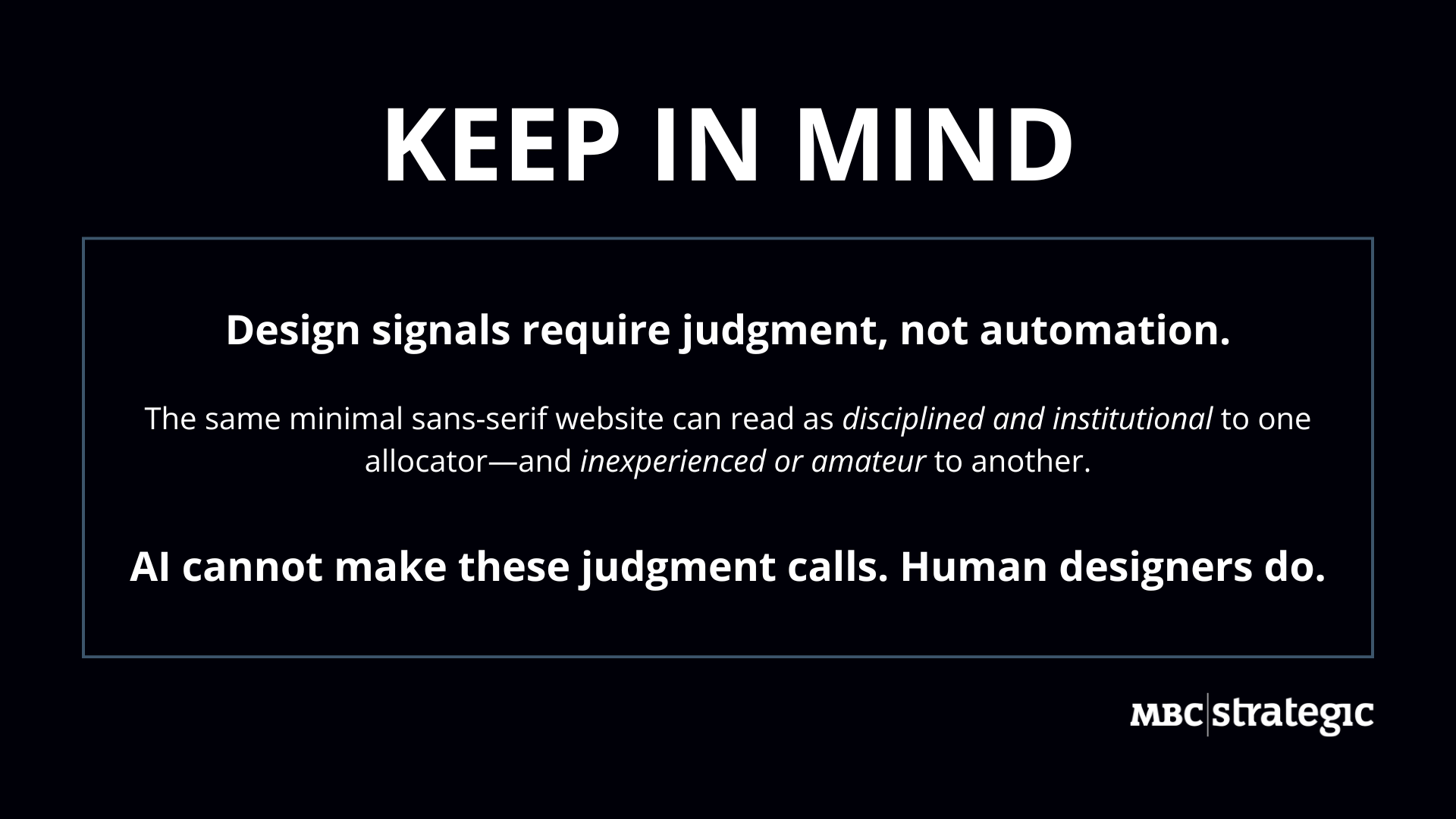
Design is not decoration in financial marketing. It signals discipline, maturity, and operational quality.
AI struggles with:
- Creating cohesive visual systems that scale branding across touchpoints
- Making subjective judgment calls that reflect institutional norms
- Designing for allocator psychology rather than aesthetic trend
3. Narrative Depth and Credibility
AI can assemble language, but it lacks the conviction that comes from lived experiences and real world judgement. In practice, AI-generated content tends to mirror existing language patterns rather than establish original points of view.
It does not:
-
- Understand the internal realities of an investment organization
- Weigh what should remain unsaid
- Shape narratives that anticipate allocator skepticism
Experienced readers often recognize AI-authored content through subtle but consistent signals (e.g., predictable sentence structures, high-frequency word choices, and overused punctuation), which erode credibility even when the content is technically sound.
Institutional audiences read marketing as subtext and quickly assess whether content reflects original thinking or recycled language. They infer process quality, risk awareness, and governance maturity from how information is framed.
“AI’s limitations become most visible in areas that directly influence trust, credibility, and differentiation.”
What Happens When Firms Rely Too Heavily on AI
When firms lean too heavily on AI for creative and strategic output, three issues emerge.
FIRST: brand convergence. AI-trained content pulls from the same public inputs, so firms end up describing themselves in increasingly similar ways.
SECOND: erosion of trust signals. Allocators and consultants can spot generic language, templated design, and shallow narratives immediately.
THIRD: internal confusion. Without a clear human-led strategy, AI output can fragment messaging across teams and channels rather than align it.
How Investment Firms Should Combine AI and Human Expertise
The strongest marketing organizations use AI to accelerate execution while keeping strategic and creative accountability with people.
In practice, this integration works as follows:
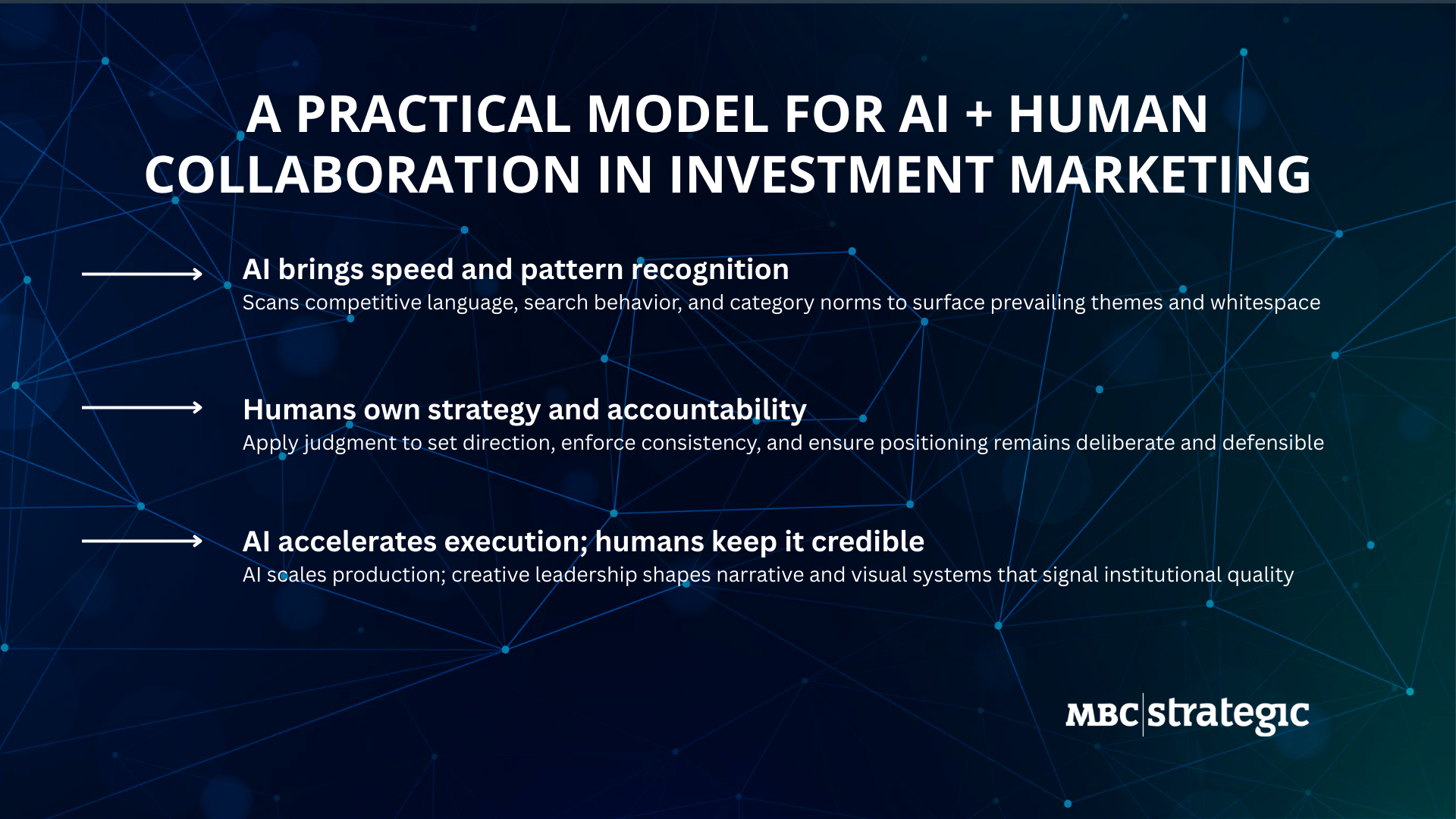
Remember: content ultimately represents a firm’s thinking in public, which is why ownership and accountability cannot be automated.
Beyond that, a practical division of labor would look like this:
| AI SUPPORTS | HUMAN TEAMS LEAD |
|---|---|
| Research, synthesis, and operational efficiency | Brand strategy and positioning |
| Content drafting, scaling, and optimization | Creative direction and design systems |
| Performance tracking and refinement | Narrative development and editorial judgment |
| Automated prospect engagement | Investor psychology and institutional signaling |
This model allows firms to move faster without sacrificing originality or credibility.
Why Creative Differentiation Still Determines Marketing Effectiveness
In institutional markets, differentiation is evaluated through early screening, comparative review, and due diligence. Allocators look for signals of clarity of mandate, disciplined process, and organizational maturity. Tone, narrative coherence, and storytelling shape how those signals are interpreted. Marketing functions as evidence of how a firm thinks, decides, and operates. This demands:
-
- Clarity of mandate and process (what the firm does and does not do)
- Consistency across every channel and touchpoint
- Signals that reduce perceived risk during evaluation and due diligence
These outcomes are the result of judgment and restraint. They require decisions about emphasis, omission, and framing that reflect real operating context. No level of automation can substitute for that discernment.
“As content production becomes easier, differentiation becomes harder to sustain—and easier to misjudge.”
The MBC AI Marketing Perspective
AI has real value in modern investment marketing. Ignoring it creates inefficiency. Relying on it without governance creates sameness and weakens authorship.
The advantage lies in deliberate integration. Firms need clear boundaries for where AI accelerates execution and where human judgment remains non-negotiable—particularly in positioning, narrative, and design decisions that shape credibility.
Marketing is a public expression of a firm’s investment thinking. When strategy, messaging, and creative direction are owned and directed by experienced teams—and supported by AI rather than defined by it—marketing reinforces confidence, differentiation, and long-term capital formation.
Frequently Asked Questions about ai in asset management marketing
1. Is AI replacing investment marketing teams?
A: No. AI is replacing manual tasks, not strategic thinking or creative leadership.
2. Can AI create effective investment marketing content?
A: AI can support content production, but effectiveness depends on human-led strategy, editing, and judgment.
3. Should we disclose AI use in our marketing materials?
A: Disclosure isn’t currently required, but authenticity matters. If AI drafts initial content that humans then refine and approve, that’s a workflow tool—not misrepresentation. The test is whether a human would stand behind every claim and creative decision.
4. Can AI help with regulatory compliance in asset management marketing content?
A: AI can flag common compliance risks and standardize disclaimer language, but it can’t assess whether specific claims cross regulatory lines in your jurisdiction. Final compliance review must remain a human responsibility, ideally with legal oversight.
5. Why does creative still matter if AI improves efficiency?
A: Because allocators and sophisticated investors evaluate credibility, not just information. Creative quality influences trust.
6. How should investment firms use AI today?
A: As a workflow and intelligence layer, guided by clear positioning and creative direction.