
White Paper: Benchmarking Your Financial Marketing
A Scoring framework for evaluating brand strength, marketing performance, and AI search visibility for investment firms and financial institutions.
MBC Strategic Research Team | Published May 2026
Investment firms benchmark portfolio performance against indices and peers. Marketing deserves the same discipline. Without a benchmark, there’s no reliable way to know whether your brand is positioned to win, whether your content is driving qualified engagement, or whether AI platforms are representing your firm accurately before a prospect ever reaches your website.
Get the Benchmarking framework →
What Is a Financial Marketing Benchmark?
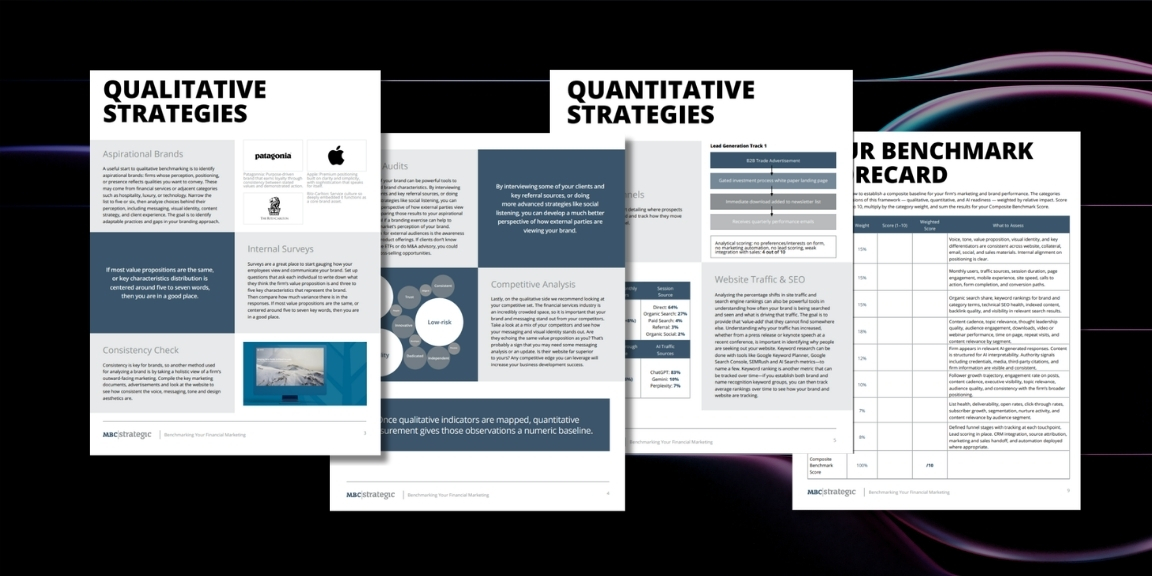
A financial marketing benchmark combines qualitative measures, including brand perception, competitive differentiation, and messaging consistency, with quantitative data: website traffic, email engagement, funnel quality, and AI search visibility. Together, they provide a baseline to evaluate what’s working, identify gaps, and measure the impact of marketing initiatives over time.
How to Benchmark Investment Firm Marketing
Brand Clarity
Can employees, clients, and referral sources describe your firm consistently? Internal surveys and external audits frequently reveal a gap between how a firm sees its own value proposition and how the market perceives it.
Competitive Differentiation
Messaging around trust, experience, and long-term relationships is nearly universal in financial services. Competitive benchmarking identifies whether your positioning is genuinely distinct or blends into industry noise.
Marketing Consistency
A consistency audit examines whether your website, investor pitch materials, thought leadership, and integrated campaigns present a unified identity. Inconsistency across touchpoints weakens brand recall and reduces AI summary accuracy.
Website, SEO, and AI Referral Performance
Traffic trends, session source mix, keyword rankings, and new user acquisition indicate whether qualified audiences are finding and engaging with your investment firm content marketing. AI traffic sources, including ChatGPT, Perplexity, Claude, and Gemini, should now be tracked separately.
Email and Content Engagement
The white paper cites a 20% open rate and 3% click-through rate as useful baseline targets for many financial services email programs. A/B testing subject lines and content format helps identify what generates meaningful engagement beyond passive receipt.
Marketing Funnel Quality
A funnel scoring exercise maps where prospects enter your marketing program and how they move through it. Gaps in lead scoring, automation, and sales integration are common findings, regardless of top-of-funnel volume.
AI Search Visibility
Prospects are beginning their research inside AI platforms before they reach your website. Benchmarking AI visibility means assessing whether your firm appears in relevant AI-generated responses, how often it is cited, and whether those summaries accurately reflect your positioning and differentiators.
Why AI Readiness Is Now a Benchmarking Category
Your firm may be summarized, categorized, and compared by AI before a prospect ever engages directly. In AI marketing for investment firms, three dimensions matter:
AI Search Visibility: In which queries does your firm appear? How often are you cited in category or comparative prompts? Year-over-year citation frequency indicates whether you are defining the category narrative or appearing inside a competitor’s framing.
AI Interpretability: AI platforms prioritize well-structured content organized around user intent. Unstructured or inconsistent messaging risks being diluted or misrepresented in AI-generated summaries. Firms with clearly expressed, consistently reinforced differentiators are easier to surface accurately.
AI Authority Signals: AI systems weight sources that demonstrate consistent expertise and verifiable authority. Credentials, thought leadership, awards, partnerships, and media references need to be visible and aligned across channels for AI to interpret your firm as a category leader.
Who Should Download This White Paper
This white paper is for marketing and business development professionals at asset managers, RIAs, wealth managers, private equity firms, hedge funds, and financial institutions, particularly those preparing for a brand refresh, website redesign, content strategy update, or AI search optimization initiative.
MBC Strategic specializes in marketing, branding, and communications for investment firms and financial institutions.
Download the Framework and Score Your Marketing Program →